The 7 principles of HACCP, explained for care home kitchens
HACCP stands for Hazard Analysis and Critical Control Points. It sounds technical, but it's really a simple idea: work out what could make your residents ill, decide how you'll stop it, check that you do, and keep the proof. This guide takes each of the 7 principles in turn, with a care home example and what the Environmental Health Officer (EHO) will look for.
In short: a care home that cooks for residents is a food business, and the law says its food safety system must be based on the 7 HACCP principles. In plain English: (1) find the hazards, (2) find the steps that must be controlled, (3) set a safe limit for each, (4) check it every time, (5) know what to do when a check fails, (6) make sure the whole system works, and (7) keep the records.
- 1Hazard analysis
- 2Critical control points
- 3Critical limits
- 4Monitoring
- 5Corrective action
- 6Verification
- 7Records
- ★Worked example
Why HACCP matters more in a care home
Older people, and people living with long-term illness, are more likely to become seriously ill from food poisoning, and slower to recover. Many residents can't tell you that food tastes wrong or that they feel unwell. Some are on texture-modified diets, where the wrong texture is a choking risk. And allergies have to be managed for people who may not remember they have them.
That is why the EHO expects a care home's food safety plan to be thorough, and to be followed, not just filed. HACCP is how you show both.
1Conduct a hazard analysis
Go through every step of how food moves through your kitchen, from delivery to the resident's plate, and ask what could go wrong at each one.
- The four kinds of hazard
- Biological (bacteria such as Salmonella, Listeria, E. coli O157 and Clostridium perfringens), chemical (cleaning products, pest control), physical (glass, bone, plastic, hair) and allergens. In a care home, choking on food or drink of the wrong texture belongs on the list too.
- Care home example
- A cottage pie cooked in the morning, cooled, kept in the fridge and reheated for tea has hazards at cooking (bacteria surviving), cooling (spores growing while it cools slowly), storage (fridge too warm), reheating (not hot enough) and serving (wrong texture for a resident on IDDSI level 4).
- What the EHO looks for
- A list of your steps that matches what your kitchen actually does, including the care-home extras: texture-modified meals, thickened drinks, snacks and food from visitors.
2Identify the critical control points (CCPs)
A critical control point is a step where you must control a hazard, because nothing later in the process will remove it. Not every step is a CCP. Most are covered by good hygiene basics (often called prerequisites) such as cleaning, handwashing, pest control and staff training.
- Typical CCPs in a care home kitchen
- Cooking, cooling, reheating and hot holding, plus allergen control and making texture-modified food and thickened drinks to each resident's prescribed level.
- What the EHO looks for
- That you know which steps are critical and why, and that your staff know too.
3Set critical limits
Give each CCP a measurable pass/fail line, so anyone on shift can tell straight away whether the food is safe.
- Common limits
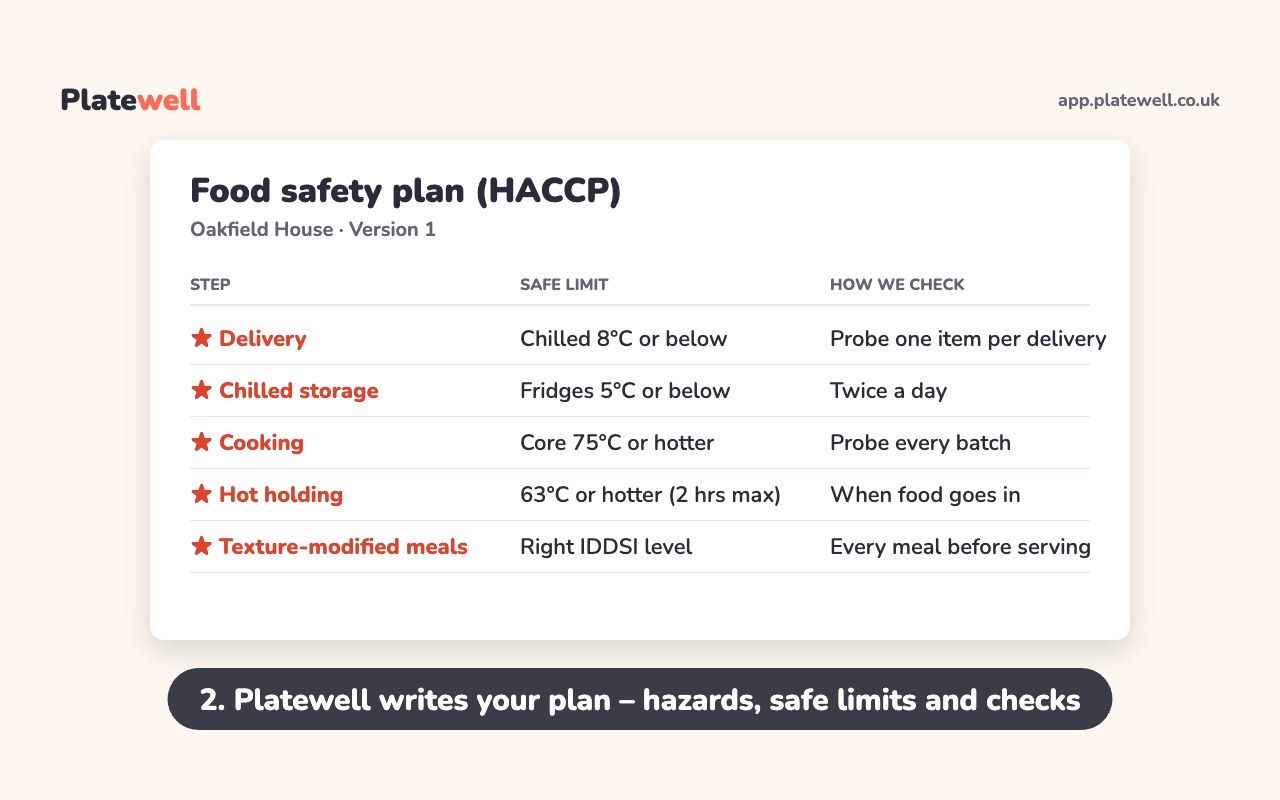
- Cooking to a core temperature of 75°C or hotter (FSA guidance, or an equivalent time and temperature). Reheating to 75°C or hotter (82°C is the law in Scotland). Hot holding at 63°C or above. Cold food at 8°C or below, with fridges best kept at 5°C or below. Freezers at −18°C or below. Cooked food cooled quickly, usually within 90 minutes, before it goes in the fridge. Texture-modified food and drinks passing the IDDSI test for the resident's level.
- What the EHO looks for
- Limits written down, and staff who know them without looking.
4Monitor the CCPs
Decide what is checked, how, how often and by whom. Then do it, and write it down every time. Monitoring is what proves your plan is followed every day, not just on paper.
- Care home example
- Probe the cottage pie and write down the temperature. Read and record every fridge and freezer twice a day. Probe the hot trolley before it leaves the kitchen. Check each texture-modified plate against the resident's level before service.
- What the EHO looks for
- Records that are complete, done at the time, with no gaps on busy days, and a probe thermometer that works.
5Take corrective action
Decide in advance what happens when a check fails. Then do it, and record what you did.
- Care home example
- The cottage pie probes at 68°C: keep cooking and probe again until it reaches 75°C. A fridge reads 9°C: move the high-risk food to another fridge, check how long it has been warm, throw away anything that may be unsafe, and get the fridge fixed. A puréed meal fails the spoon tilt test: don't serve it, and remake it.
- What the EHO looks for
- That problems are spotted, put right and written down. A diary with a few problems that were dealt with properly is more believable than one where nothing has ever gone wrong.
6Verify that the system works
Step back and check that the whole system is working, not just each check.
- Care home example
- The manager looks over the records each week and signs them off. The probe thermometer is checked in iced water (about 0°C) and boiling water (about 100°C). The plan is reviewed regularly, and straight away when the menu, a supplier, equipment or the way you work changes, or after a problem.
- What the EHO looks for
- Evidence that someone in charge checks the records and keeps the plan up to date.
7Keep records and documentation
Write the plan down and keep records that show you follow it. If something ever goes wrong, your records are your evidence that you took all reasonable care (sometimes called due diligence).
- What to keep
- Your written plan, temperature and probe records, opening and closing checks, cleaning records, deliveries, problems and what you did, staff training, and plan reviews.
- What the EHO looks for
- A plan that matches your kitchen, and records that are easy to find and show the plan is followed.
Worked example: four CCPs in a care home kitchen
Here's how the principles fit together for some of the most common critical control points. Your own plan should be based on what your kitchen actually does.
| CCP | Critical limit | Monitoring | Corrective action | Record |
|---|---|---|---|---|
| Cooking | Core 75°C or hotter | Probe the thickest part of every batch | Keep cooking and probe again | Cooking check with time, temperature and initials |
| Cooling | Cooled quickly, usually within 90 minutes, then into the fridge | Time and probe when it goes in the fridge | Divide into smaller portions, use a colder method, or throw away if too slow | Cooling check |
| Hot holding | 63°C or above | Probe before service and during | Reheat to 75°C (once only) or throw away | Hot-holding check |
| Texture-modified meals | Passes the IDDSI test for the resident's level | Test each batch; check each plate against the resident's level | Don't serve; remake to the right level | Plate check and named plate label |
HACCP and Safer Food, Better Business
You don't need a consultant-written manual. The law lets small kitchens apply the HACCP principles in a simple way that fits the size of the business.
- Safer Food, Better Business (SFBB) is the Food Standards Agency's pack for small caterers, and it is based on the HACCP principles. Small residential care homes in England, Wales and Northern Ireland use the caterers pack together with the FSA's residential care homes supplement.
- Nursing homes: the FSA says the care homes supplement is not intended for nursing homes, which need other food safety procedures.
- Scotland: the equivalent is CookSafe, from Food Standards Scotland.
- A digital system like Platewell works the same way: a food safety plan based on HACCP principles, plus the daily records that prove it's followed.
Common gaps an EHO finds
- The plan doesn't match the kitchen. A bought-in template that mentions equipment you don't have, or misses steps you do, like cooling or thickened drinks.
- Gaps in the records. Blank days, or temperatures all filled in at once at the end of the week.
- Problems with no action written. A fridge at 10°C with nothing recorded about what happened to the food.
- No review. A plan dated three years ago, from before the new menu, new cook or new combi oven.
- Care staff left out. The kitchen knows the plan, but the carers serving food and drinks on the floor don't.
Where software helps
Paper works, as long as every check gets done and written down at the time and someone keeps the plan up to date. That's the hard part. Platewell, our kitchen software for independent care homes, drafts a food safety plan based on HACCP principles from simple Yes/No questions, for you to check and approve. It then runs the daily checks on any phone or tablet and keeps the records ready for your EHO. Inside the app, a "7 HACCP principles" page shows how your plan covers each principle and where your home stands today.
You can try it free for 14 days with no card needed, or watch how the food safety plan is drafted.
This guide is general information, not legal advice. Platewell drafts a plan for you to check: your home stays responsible for making sure it matches how your kitchen really works, and no one can promise a food hygiene rating. Ask your local council's food safety team if you're unsure what applies to your home.
Sources
- Food safety management systems: the HACCP principles (GOV.UK)
- Safer food, better business for caterers (Food Standards Agency)
- Safer food, better business supplement for residential care homes (Food Standards Agency)
- CookSafe manual (Food Standards Scotland)
- General Principles of Food Hygiene, CXC 1-1969 (Codex Alimentarius)
- The IDDSI framework (IDDSI)