Allergens in care homes: what the rules say and a simple daily routine
A busy care home kitchen serves dozens of different plates a day, often to residents who can't check their own food or tell you if something is wrong. This guide sets out what the rules expect, and a routine that keeps allergens under control without drowning your cook in paperwork.
In short: know which of the 14 allergens are in every dish you serve, keep one up-to-date list of every resident's allergies, textures and diets, check each plate against that list before it leaves the kitchen, and update both lists whenever a recipe, supplier or resident changes.
Why allergens are harder in a care home
In a restaurant, the customer asks about allergens. In a care home, many residents can't. Someone living with dementia may not remember an allergy, may not recognise a dish, or may not be able to say they feel unwell. The responsibility sits with the home.
On top of that, care home kitchens deal with things a café doesn't: texture-modified meals, fortified foods, a rotating menu, residents changing rooms, and agency or new staff serving plates who don't yet know everyone. Most slip-ups happen in the handover between the kitchen and the care team, not at the stove.
The 14 allergens
UK food law names 14 allergens that food businesses must be able to tell people about when they are in a dish:
- Celeryincluding celeriac, and celery salt in stocks and seasonings
- Cereals containing glutenwheat, rye, barley, oats
- Crustaceansprawns, crab, lobster
- Eggsincluding in batters, mayonnaise and glazes
- Fishincluding in some sauces and dressings
- Lupinflour and seeds, sometimes in bread and pastry
- Milkincluding lactose, butter, cream and milk powder
- Molluscsmussels, squid, oyster sauce
- Mustardincluding in dressings, marinades and sauces
- Tree nutsalmonds, hazelnuts, walnuts, cashews, pecans, Brazil nuts, pistachios, macadamias
- Peanutsincluding groundnut oil and satay
- Sesameseeds, oil and tahini
- Soyaincluding soya flour and lecithin
- Sulphur dioxide and sulphitesabove 10 mg per kg or litre: dried fruit, some drinks and sausages
What the rules expect of a care home kitchen
1. Food information rules: know what's in every dish
A care home that prepares food is a food business. It registers with the local council and is inspected for food hygiene like any other. The food information rules apply to all food supplied by food businesses, including meals that aren't prepacked, such as a plated lunch.
For that food, allergen information must be available for the whole dish as served. The rules let you give it in any way, including verbally, but the information has to be accurate and backed up, for example by a chart or recipe book. The Food Standards Agency's best practice is to have written allergen information for every dish, backed up by a conversation.
For a care home, the practical answer is an allergen chart (often called a matrix): every dish on your menu cycle down the side, the 14 allergens across the top, kept up to date.
2. CQC Regulation 14: meet each person's nutrition needs
In England, CQC's Regulation 14 covers meeting nutritional and hydration needs. Its guidance says that assessments should identify dietary intolerances and allergies, that where a person is assessed as needing a specific diet it must be provided in line with that assessment, and that people's preferences, religious and cultural needs must be taken into account. People should also be able to make choices about their diet.
In practice, an inspector will want to see that what's in the care plan reaches the kitchen, and that what leaves the kitchen matches the care plan.
3. Natasha's Law: usually not for residents' meals
Natasha's Law covers food that is prepacked for direct sale, meaning packed on the premises before a customer chooses it. It doesn't apply to meals prepared and served directly to residents. But if your home packs sandwiches, cakes or salads on site to sell, for example in a café or shop for visitors, those need a full ingredients label with allergens emphasised.
Scotland, Wales and Northern Ireland: the food information rules and the 14 allergens are the same, but care homes are regulated by the Care Inspectorate, Care Inspectorate Wales or RQIA rather than CQC. Check your regulator's own standards on food and nutrition.
Texture is part of the same job
Many homes keep allergens and textures in separate folders, but on the plate they are one check: is this the right food, in the right form, for this person?
The UK uses the IDDSI framework for texture-modified food and thickened drinks. Food levels run from 3 (liquidised) to 7 (regular), and drink levels from 0 (thin) to 4 (extremely thick). The level for each resident should come from their assessment, usually by a speech and language therapist. The kitchen records it and serves it correctly at every meal and snack.
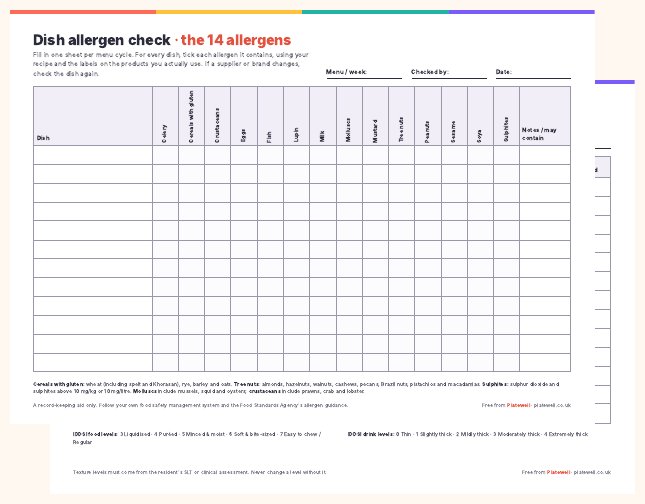
Free printable check sheets
An allergen chart for your dishes, a resident allergies, texture and diet list, and a plate check for each meal. Three A4 pages, with no sign-up.
Get the free sheetsA simple daily routine
- Keep an allergen chart for every dish. Work from your recipes and the labels on the products you actually buy, not from memory. Include sauces, gravies, stocks, desserts and snacks.
- Keep one list of every resident's needs. Record allergies, intolerances, IDDSI food and drink levels, diets (diabetic, vegetarian, halal and so on), likes and dislikes. One copy for the kitchen, one for the care team, both the same version.
- Update both on day one. When someone is admitted, or their care plan or texture level changes, the kitchen list changes the same day, not at the next monthly review.
- Take meal choices against the list. When residents choose their meals, check the options against their needs first, so nobody chooses something they can't have.
- Check every plate before service. Before plates leave the kitchen, check each one against the list for allergens, texture and diet, and label it with the resident's name. A named plate is much harder to give to the wrong person.
- Record changes and substitutions. If a dish runs out and something else goes out instead, check and note it. Substitutions are where errors creep in.
- Train everyone who serves food. That includes carers and agency staff, not just the kitchen. They need to know where the list is and to check before serving.
Common slip-ups to watch for
- A supplier changes a product. Same name, new recipe, new allergens. Check labels on deliveries, especially substitutes.
- Hidden ingredients. Gravy granules, stock cubes, thickeners, custard powder, Worcestershire sauce (fish) and milk powder in fortified meals.
- Cross-contamination. Shared fryers, toasters, chopping boards and serving spoons.
- Food from visitors. Make sure families know how to check with staff before giving residents food from outside.
- Lists that drift apart. When the kitchen list and the care plan disagree, nobody is sure which is right. Keep one source of truth.
Where software helps
Paper works, as long as someone keeps every list in step. That's the hard part. Platewell, our kitchen software for independent care homes, keeps the dish allergens and every resident's allergies, textures and diets in one place. It greys out dishes a resident can't have on their menu sheet, then prints the kitchen sheet and a named label for every plate. You can try a demo care home without signing up, or read how Platewell handles allergens and textures.
This guide is general information, not legal advice. Follow your own food safety management system and your regulator's standards, and ask your local council's food safety team if you're unsure what applies to your home.
Sources
- Food allergen labelling and information requirements: technical guidance (Food Standards Agency)
- Updated guidance on allergen information for non-prepacked food (Food Standards Agency)
- Introduction to allergen labelling changes (PPDS) (Food Standards Agency)
- Regulation 14: Meeting nutritional and hydration needs (CQC)
- The IDDSI framework (Royal College of Speech and Language Therapists)