IDDSI levels explained: a quick guide for care home kitchens
Texture-modified food and thickened drinks keep residents with swallowing difficulties safe – but only if every plate is at the right level. Here's what each IDDSI level means and how to check it.
In short: IDDSI gives every texture a number. Drinks run from 0 (thin) to 4 (extremely thick); foods from 3 (liquidised) to 7 (regular). The level for each resident comes from their assessment, usually by a speech and language therapist – the kitchen's job is to record it, make it right, and check it on every plate.
What IDDSI is
IDDSI – the International Dysphagia Diet Standardisation Initiative – is a shared set of names, numbers and simple tests for texture-modified food and thickened drinks. It replaced older labels like "stage 1 thickened" or "fork mashable", which meant different things in different places. UK speech and language therapists and dietitians adopted it, and it's now the language used in care plans, hospital discharge letters and on thickener and texture-modified meal packs.
Because the levels are numbered and tested the same way everywhere, a resident coming back from hospital on "Level 5" should get the same texture in your dining room as they did on the ward.
Drinks: levels 0 to 4
Drinks are checked with the IDDSI flow test: fill a 10 ml syringe, let it run for 10 seconds, and see how much is left.
| Level | Name | Flow test (left after 10 seconds) | What it's like |
|---|---|---|---|
| 0 | Thin | Empties completely | Flows like water. Any cup or straw. |
| 1 | Slightly thick | 1–4 ml | Thicker than water, but still flows through a straw. |
| 2 | Mildly thick | 4–8 ml | Pours quickly off a spoon, but slower than thin drinks. Can be sipped. |
| 3 | Moderately thick | More than 8 ml | Can be drunk from a cup; takes effort through a straw. |
| 4 | Extremely thick | Too thick for the flow test | Eaten with a spoon. Holds its shape and doesn't pour. Same as level 4 food. |
Foods: levels 3 to 7
| Level | Name | What it's like |
|---|---|---|
| 3 | Liquidised | Smooth, no lumps, pourable. Can be drunk from a cup or eaten with a spoon. |
| 4 | Puréed | Completely smooth with no lumps, and moist enough to hold its shape on a spoon. No chewing needed. |
| 5 | Minced & moist | Soft and moist, with small lumps no bigger than about 4 mm – the gap between the prongs of a standard fork. Mashes easily with light fork pressure. |
| 6 | Soft & bite-sized | Soft, tender pieces no bigger than 1.5 cm for adults. Can be mashed with a fork; needs some chewing. |
| 7 | Regular | Normal everyday food. There's also an "easy to chew" version of level 7 for people who need soft food but don't have a swallowing difficulty. |
Checking it in the kitchen
IDDSI tests are designed to be done with what's already in a kitchen:
- Flow test (drinks): a 10 ml syringe and a timer, as in the table above.
- Fork drip test (levels 3–5): how the food sits on, or drips through, the prongs of a fork.
- Spoon tilt test: whether a spoonful slides off cleanly when tilted, rather than sticking – stickiness is a choking risk.
- Fork pressure test: press with the back of a fork. Food at levels 5 and 6 should squash and not spring back.
- Size check: 4 mm (fork prong gap) for level 5, 1.5 cm (about the width of a thumbnail) for level 6.
The full test instructions, with photos and videos, are on the IDDSI website. It's worth printing them for the kitchen wall.
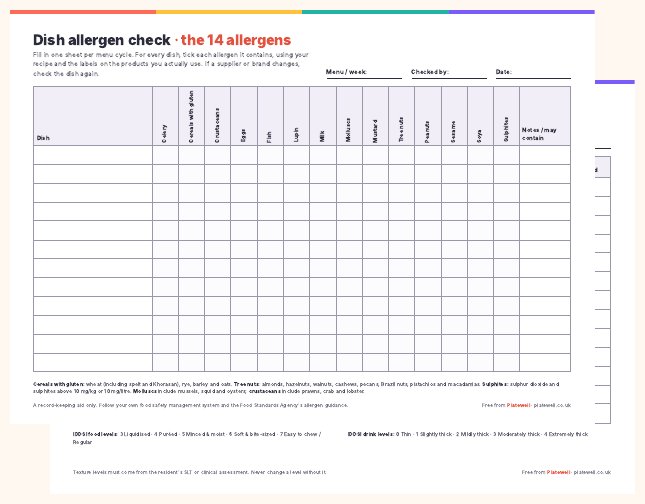
Free printable texture and allergen sheets
A list of every resident's IDDSI food and drink levels, allergies and diets, and a plate check for each meal – with the IDDSI levels printed on. No sign-up.
Get the free sheetsA simple routine for the kitchen
- Take the level from the assessment. Record each resident's food and drink level exactly as their speech and language therapist or dietitian set it – never guess or "go one softer to be safe" without advice.
- Keep one list, shared. The kitchen and care team should work from the same list. When a level changes, update it the same day.
- Make it the same way each time. Use standard recipes and the thickener maker's instructions for each level – scoops differ between brands.
- Test before serving. Especially for new recipes, new staff, or anything reheated or left standing, which can thicken or separate.
- Label every plate. A plate with the resident's name and level is much harder to give to the wrong person.
- Watch the whole meal. Puddings, snacks, drinks between meals and food from visitors all need to be at the right level too.
Common slip-ups
- Mixed textures. Soup with bits, cereal in milk, or juicy fruit – thin liquid and lumps together are hard to manage safely.
- Hard, dry or crumbly food. Crackers, toast, crumble toppings and dry mince usually need changing or avoiding at levels 4–6.
- Pieces too big. Level 6 pieces creeping above 1.5 cm on a busy service.
- Drinks left to stand. Some thickened drinks keep thickening, so a level 2 can become a level 3.
- Lists out of step. The kitchen still working to last month's level after a review.
Where software helps
Platewell, our kitchen software for independent care homes, keeps every resident's IDDSI food and drink level with their allergies and diets. It shows the level on their menu sheet, on the kitchen sheet and on a label for every plate, so the right texture reaches the right person. You can try a demo care home without signing up.
This guide is general information for kitchens, not clinical advice. Always follow each resident's assessment and your speech and language therapist's or dietitian's instructions.
Questions
Who decides a resident's IDDSI level?
The resident's assessment sets it – usually by a speech and language therapist, sometimes with a dietitian. The kitchen records the level and serves food and drink at that level every time.
What's the difference between level 4 drinks and level 4 food?
They're the same texture. Level 4 'extremely thick' drinks and level 4 'puréed' food are both smooth, hold their shape and are eaten with a spoon.
How do you test a thickened drink?
Use the IDDSI flow test: fill a 10 ml syringe, let it flow for 10 seconds, then measure what's left. 1–4 ml is level 1, 4–8 ml is level 2 and more than 8 ml is level 3.
Sources
- IDDSI testing methods (IDDSI)
- IDDSI fluid levels and information (St George's University Hospitals NHS)
- The IDDSI framework (Royal College of Speech and Language Therapists)